



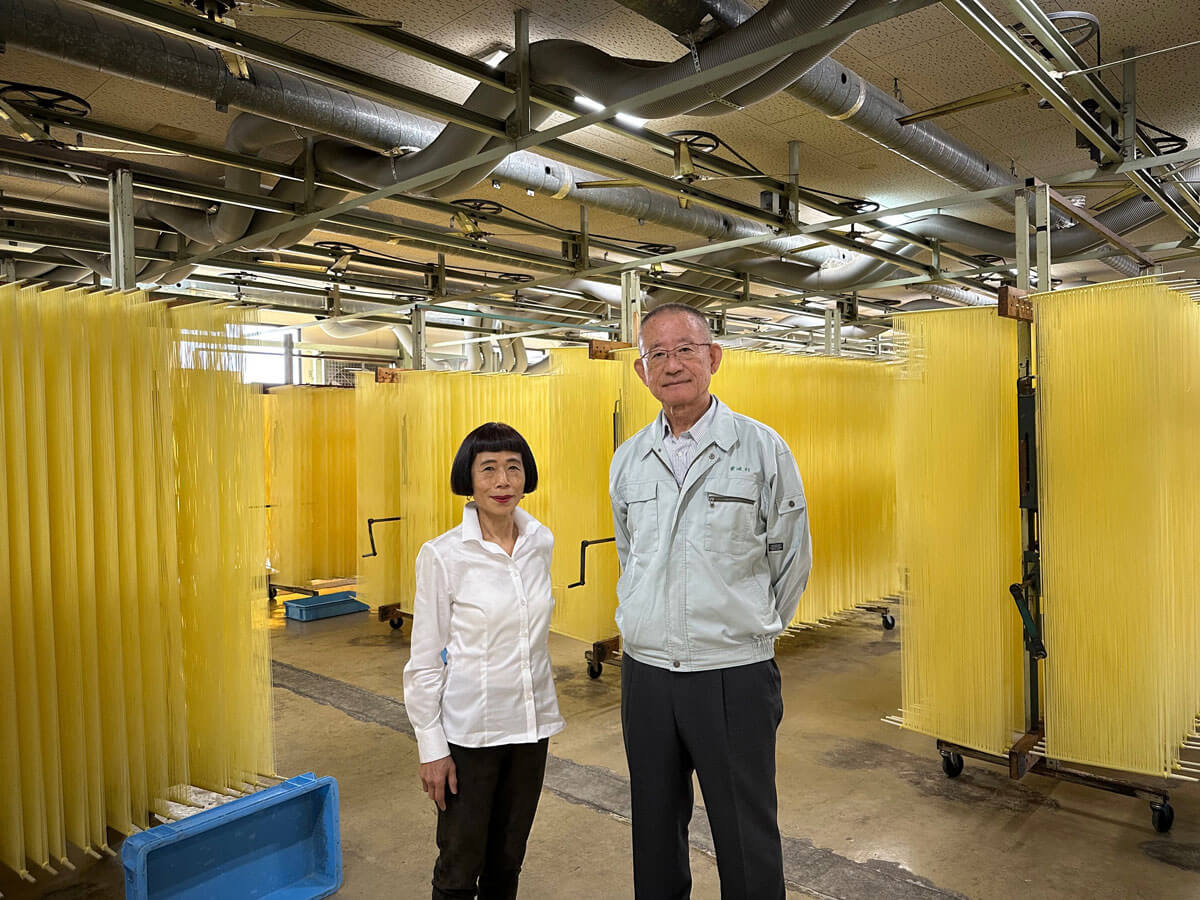
I visited Ikeri Somen Company in Miwa, Nara Prefecture, in October, to learn about the history of somen noodles and why they became so thin – needle-thin!
The original form of somen noodle was a deep-fried, twisted, thick, rope-shaped wheat snack called Sakubei, brought to Japan from China during the Nara period (710-794). Sakubei has no resemblance to today’s somen noodles.

Left: Sakubei / Right: Transformation to Thin Noodles
The gradual, radical transformation of the Sakubei to today’s noodle form took place during the Muromachi period (1336-1573). The force of this transformation lies in the cloud. By the Edo period (1600-1868), the somen noodle, which was yet thicker than today’s standard, had become popular among the city dwellers.

Image credit: Ishikawa Prefectural Museum of History
Ikeri Somen Company, a leader in the somen noodle industry, was founded in 1850 in the Miwa region of Nara Prefecture. At the time of my visit, Mount Miwa, considered a sacred mountain, dominated the view from the company's windows. A dignified shrine, Omiwa Jinja, stands at the foot of Mount Miwa.

Mt. Miwa, as seen from Ikeri Somen Company
According to legend, a natural disaster struck the region in the early 9th century.
The residing God in the mountain instructed the local priest to plant wheat and make noodles to save people. This mythology appears in the ancient texts Kojiki (711-712) and Nihon Shoki (720). The somen industry respects the history and has a close relationship with the God of Mt. Miwa.

Above: Omiwa Shrine
Every February, somen industry representatives across the country gather and attend a ritual Shinto ceremony, called Bokujosai, at Omiwa Jinja. The outcome of the ceremony determines the opening price of the year's somen noodles.

Above: Bokujosai, a ritual Shinto ceremony
Somen is made of wheat, salt, and clean water, just like udon noodles.
For the udon noodles, the kneaded dough is rested, then thinly flattened and cut into strips. It is simple enough that everyone can enjoy making udon at home.

Somen production is a different story. Production involves time, labor, and complicated sets of tasks.
The kneaded dough is cut into a thick rope and rested to develop gluten, with an application of some oil twisted and stretched into a thinner rope, rested again for several hours; the dough is then pulled to stretch until the diameter of each noodle is about 1.3mm; the noodles are hung to dry before cutting into a designated length of 19cm (7.6 inches). The cut noodles are neatly bundled into 50g (1.76 ounces) batches.

Here is a video of somen production at Ikeri Company:
During the visit, I had a hands-on noodle-pulling experience. I learned that stretching noodles required strength and great care.
Today at Ikeri Somen Company, much of the production process is automated, but the entire process is assisted by highly skilled human labor.

To preserve the somen culture, Ikeri Somen Company has been diversifying its products and service offerings. Creating colored somen noodles is one of them. The Company carries seven colored noodles: Yuzu citrus, kabocha squash, gobo (burdock), tomato, spinach, purple sweet potato, and plain white.

After the factory visit, I tried three different grades of traditional somen noodles and four colored ones at the Company’s noodle restaurant, Senjutei. The somen was served with two conventional dipping sauces - dashi-and-shoyu-based and sesame paste-based, and one modern dipping sauce - a tomato-based.
The texture of quality somen in each dipping sauce was eye-opening – it is extremely chewy and has a smooth mouthfeel!
During the meeting at the Company, Chairman Ikeda-san repeatedly stated that consumers’ strong preference for thinner, whiter somen noodles over the centuries has led to the refinement and creation of needle-thin, white noodles.
Repetitive pulling and resting during production creates microscopic air pockets that coalesce into a band-like structure near the center of the noodle during drying, which helps create the most desirable chewy texture with an excellent smooth mouthfeel.

Making somen noodles is an art form.
Ikeri Company continues to preserve the somen culture with innovation. Before leaving the Company, I learned that Ikeri Company exports its somen to America, but I couldn’t find out where I could get it. The trading company they use doesn’t share the information on where they distribute Ikeri’s somen noodles. After I return to America, I will investigate it!


