



Japanese craftsmanship permeates daily life through food production, culinary arts, food presentation, textiles, traditional gardens, architecture, and artworks.
The craftsmanship is supported by dedication, ongoing skill refinement, and respect for nature and human relationships. The meticulous somen noodle production, which I introduced in December 2025, is one such example.

During my stay in Japan in November 2025, I visited the Shoso-in Exhibition at the Ueno Royal Museum in Tokyo, which featured the treasures stored in the building through high-definition projections and replicas, including lutes.
The show was to bring ancient Japanese treasures to life without displaying their originals, which are locked with an Imperial seal in the Shoso-in building.*
Once a year, the Imperial seal is opened at the Imperial House's order for the annual inspection. The items that need repair must be done annually. At this time, a few items are selected for public display at the annual Shoso-in Treasures Exhibition in November at the Nara National Museum.

At the Shoso-in Exhibition, among many of the precious gems introduced, a lute featuring a man riding on a camel as mother-of-pearl inlay that came over the Silk Road attracted my attention.
I have seen something like this at a tiny, traditional lute workshop, Ishida Biwa-ten, near my apartment.
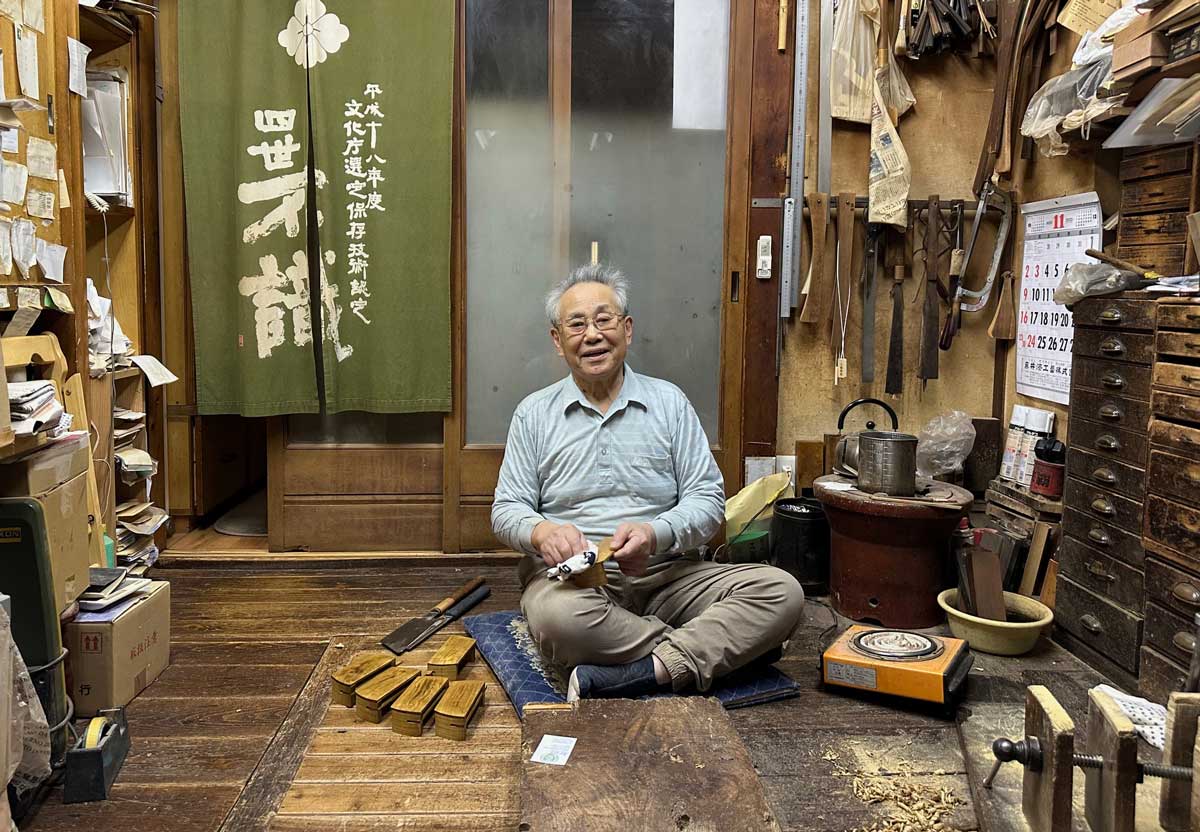
After settling into the apartment, it became a ritual for me on my way to the subway station to stop in front of the shop and stand by the glass door for 20 seconds. I was fascinated by watching an old man sitting on the floor, working on pieces of wood of different shapes and sizes, covered in wood chips, through the glass door. He looked calm and accomplished, entirely undisturbed by the noise or objects of the outer world.

The visit to the Shoso-in exhibition encouraged me to learn about his work. One day, I decided to knock on his shop door and introduce myself. His stunned expression gradually softened as he listened to why I wanted to interview him. The short 40-minute conversation revealed many wonderful stories.

Mr. Ishida is a national treasure, having worked in this trade for 46 years after inheriting the art trade name Fushiki from his father-in-law. He is a fourth-generation artist. He received many awards, including the Order of the Rising Sun, the Gold Rays Award from the Emperor.

While he was young, he was satisfied with making the instruments structurally and aesthetically sound, but struggled to create those that produce beautiful sound. The biwa players – customers of his instruments - helped him accomplish the challenging task.

The tiny workshop showcases about eight completed and soon-to-be-completed biwa instruments. All of them are of museum-quality. Among the two instruments created were those inspired by the lutes stored at the Shoso-in.
Climate change has been affecting even his business.
The supply of quality mulberry trees is difficult to acquire today. Every year, he selects and purchases a three-meter-long, two-meter-diameter log from a lumberjack, sends it to the factory, cuts it into a specific-width board, and dries it for about 10 years. He laments the declining number of biwa players and the diminished public appreciation for the instrument and the music.
He brightened me with two pieces of good news! His son, Katsuyoshi, opened his workshop as the fifth-generation Fushiki, and is making biwa instruments in Saitama Prefecture. Katsuyoshi learned to play the instrument to better understand it. He plays the biwa he made at concerts to raise awareness of this ancient instrument. His grandson is also interested in becoming the sixth-generation Fushiki!
The tiny traditional workshop, surrounded by towering skyscrapers in this modern part of Tokyo, will someday be demolished.
Everything changes, but I have a strong hope for biwa. Mr. Ishida’s son will continue his father’s trade with a new approach. I look forward to the opportunity to hear of Katsuyoshi playing the biwa in the near future.
Below is a a video on how to make a biwa instrument at Katsuyoshi’s workshop. It is mind-blowing. You need an undisturbed, quiet half-hour to watch it!
For those who wish to hear biwa storytelling music, watch the video below. Katsuyoshi, the craftman, plays it beautifully. It shows the soul of ancient Japan.
* You may have visited the Todaiji Temple and its Great Buddha Hall. The Shōsō-in (正倉院) of Todaiji Temple, Nara Prefecture, holds approximately 9,000 treasures, primarily from the 8th-century Nara Period, including personal possessions of Emperor Shōmu (701-756) and Empress Komyo (701-760), musical instruments, textiles, Buddhist items, and luxury goods from the Silk Road, offering a unique window into ancient East-West culture. The building is the azekura (log-cabin) style with a raised floor.


