




Image courtesy of Weather News
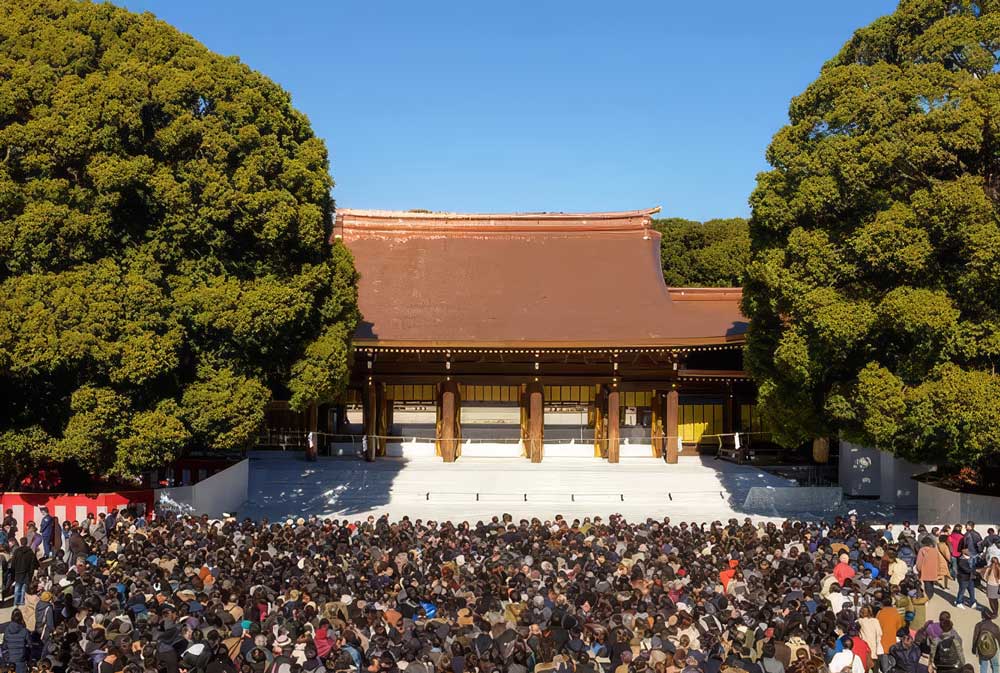
Each year, Meiji Jingu 明治神宮, Tokyo's most popular shrine, draws 3 million visitors.
“Kotoshimo Dozo Yoroshiku Onegaishimasu” is also extended to gods and ancestors. Starting early in the morning on January 1 through the first three days, the entire population visits local shrines and temples.
We deliver the message, including a New Year’s resolution, to the gods and ancestors and ask for their protection for the year.
This is called Hatsumode, 初詣.
Money matters! At the shrine, we make a monetary offering called Osaisen (お賽銭) in the large offering box in front of the main sanctuary. Here is the ritual prayer at the shrine: Gently throw the money into the offering box – money first!, make two bows, clap twice, pray silently, and finish with one bow. There is no set rule for how much to offer to God.
In the past, a 5-yen coin (pronounced ‘goen’) was popular because of its connection to “good luck”, which is also pronounced ‘goen’. Today, we offer 50 yen or 100 yen to respect God, in the hope of better luck. New Year’s offering is a different story. The average amount is around 280 yen.
How much money does Meiji Jingu collect every year over the three days of the New Year? The number is not public information, but it is a substantial amount.
New Year’s resolutions are deeply rooted in Japanese culture.
We quote, ‘Ichinen no Kei wa Gantan ni Ari 一年の計は元旦にあり’. This proverb literally means that a year’s plan should be made on New Year’s Day. Setting a goal and making plans at the beginning of the year can help people start working on projects earlier, thereby boosting achievement.
My New Year's resolution is to find a quality publisher for my fourth book, The Japanese Kitchen II (tentative title).
This fourth book features 150 new recipes and covers the philosophy and culture of Japanese cuisine. The recipes are introduced in a new systemized method. With this book, Japanese meals that promote well-being are easily accessible in every American kitchen.


